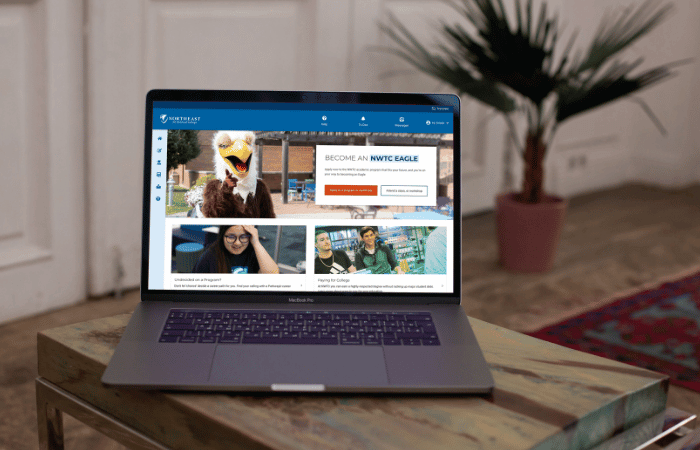
When NWTC migrated from PeopleSoft to Workday, the team saw an opportunity to rethink how students access the systems they rely on every day. Rather than sending students directly into Workday's native interface, which uses system-centric terminology and doesn't allow relabeling, the team built a standalone portal to serve as a single front door for all student traffic.
One login, one place to start, regardless of whether the task lives in Workday, Canvas, Parchment, or another system. Students don't need to know the names of the platforms the college uses. They just need to know what they're trying to do.
The previous portal had established a pattern of system-centric labeling that put the burden on students to understand the college's internal architecture. Terms like "My Financials" and "Parchment" required students to already know what those systems were and what they did, knowledge a first-generation student or returning adult learner was unlikely to have.
Workday compounded this problem by not allowing institutions to relabel its interface elements. Sending students directly into Workday would have meant accepting that terminology as the student experience. The replatform created a natural moment to address both problems at once.
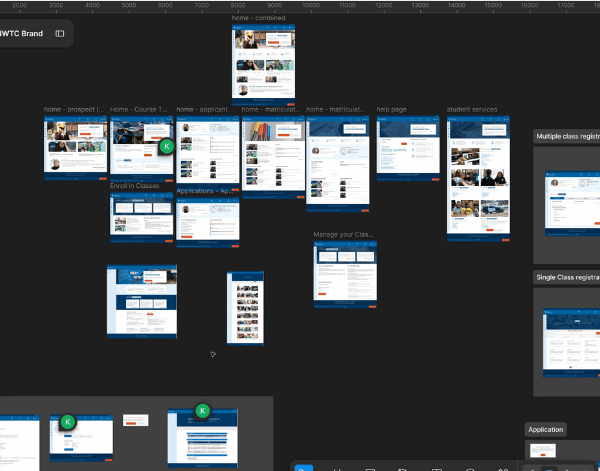
I contributed as UX designer, micro-copy writer, and embedded advisor to the IT and Enrollment teams who owned the project. I built a Figma prototype covering the account creation flow, homepage states, and navigation structure, developed collaboratively with the development team before hand-off. Because the project timeline compressed and the window for formal usability testing closed before launch, my contributions shifted toward heuristic evaluation and iterative improvement post-launch, which has continued through multiple enhancement cycles since April 2025.
The core design decision was to orient the portal around student tasks rather than system names. Instead of asking students to navigate by knowing which platform held which information, the portal presents options based on what the student is trying to accomplish — with labels written to match the student's mental model rather than the college's operational vocabulary.

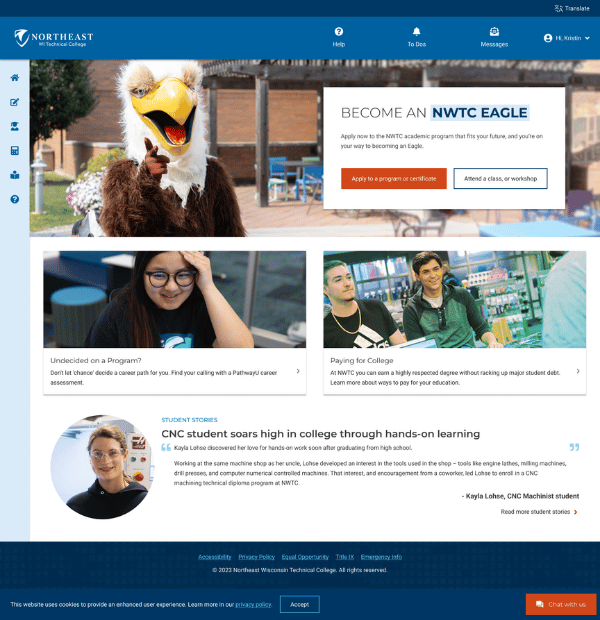
The homepage contextual content logic extends this approach to the entry experience. Rather than presenting a single static homepage, the portal detects each student's current status via Workday integration and surfaces the content most relevant to where they are:
A fourth content layer is in development: date-based contextual messaging that can be scheduled in advance to surface timely information — registration opening dates, scholarship application windows, back-to-school logistics like accessing schedules and purchasing books — based on the academic calendar rather than individual student status.
The account creation flow was also a significant design area. The account created in the portal serves as the single sign-on credential for all connected systems, so getting students through that process successfully was critical to everything downstream.

Current work includes date-based contextual messaging tied to the academic calendar, continued accessibility and UX improvements, and ongoing refinement based on usage data and heuristic review. The portal represents a living design system for the student-facing experience rather than a discrete finished product.

