(WCAG 2.1 AA Compliance Initiative)
In 2024, the U.S. Department of Justice finalized a rule requiring public institutions to make their digital services and communications accessible under WCAG 2.1 Level AA standards. For NWTC, this represented far more than a website project. It was an enterprise-wide transformation affecting websites, learning systems, documents, communications, procurement practices, and governance processes across the college.
I co-led the institution's accessibility initiative beginning in January 2025, initially partnering with our Information Security team and later with our newly appointed ADA Coordinator. Together, we worked to establish a sustainable accessibility program that would not only help the college meet compliance obligations, but also build long-term organizational capacity and improve the experience of students, employees, and community members with disabilities.
This work remains ongoing and has become one of the most significant strategic initiatives of my career.


Like many institutions, NWTC had accessibility work occurring in pockets across the organization, but there was no centralized framework for understanding:
The challenge was not simply fixing accessibility issues, it was creating an operational model that could sustain accessibility over time.
I have served as a strategic co-lead of the initiative from its inception and continue to lead the work alongside our ADA Coordinator.
My contributions have included:
This initiative significantly expanded my responsibilities beyond my day-to-day role as Digital Design & UX Strategist and required me to grow as a strategic leader, facilitator, and change agent.
Rather than approaching accessibility as a series of isolated fixes, we focused first on building sustainable institutional structures.
We established:
This framework shifted the conversation from:
"How do we fix everything?" to "How do we build an organization that can reliably produce accessible experiences?"
To support compliance efforts at scale, I led the evaluation and implementation of accessibility tooling.
After gathering requirements and meeting with multiple vendors, we selected:
I helped:
Technology alone would not solve our accessibility challenges.
To create long-term success, we focused heavily on education and support.
Key efforts included:
I personally:
The result has been the creation of an institution-wide accessibility program that combines:
The program now provides NWTC with:
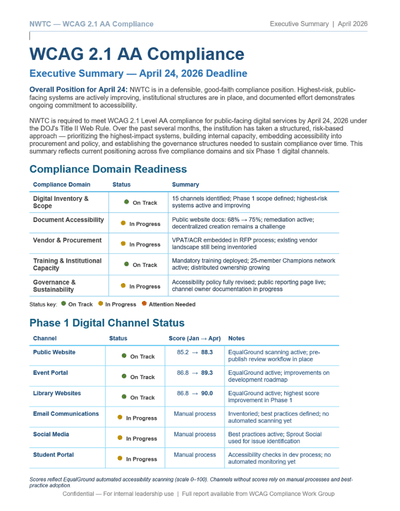
This work transformed accessibility from a technical issue owned by a handful of specialists into a shared institutional responsibility supported by governance, tools, and training.
More importantly, it created a sustainable framework that allows the college to:
This initiative remains active and continues to evolve.
Current efforts include:
While the initial focus was regulatory compliance, the initiative has grown into a broader digital transformation effort centered on inclusion, sustainability, and institutional change.

